 |
(12.39) |
A class of causal, FIR, two-channel, critically sampled, exact perfect-reconstruction filter-banks is the set of so-called Conjugate Quadrature Filters (CQF). In the z-domain, the CQF relationships are
|
(12.39) |
![\begin{eqnarray*}
h_1(n) &=& -(-1)^n h_0(L-1-n) \\ [5pt]
f_0(n) &=& h_0(L-1-n) \\ [5pt]
f_1(n) &=& -(-1)^n h_0(n) \eqsp - h_1(L-1-n).
\end{eqnarray*}](img2063.png)
That is,
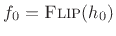 for the lowpass channel, and each highpass
channel filter is a modulation of its lowpass counterpart by
for the lowpass channel, and each highpass
channel filter is a modulation of its lowpass counterpart by  .
Again, all four analysis and synthesis filters are determined by the
lowpass analysis filter
.
Again, all four analysis and synthesis filters are determined by the
lowpass analysis filter  . It can be shown that this is an
orthogonal filter bank. The analysis filters
and
. It can be shown that this is an
orthogonal filter bank. The analysis filters
and
 are power complementary, i.e.,
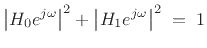 |
(12.40) |
 |
(12.41) |
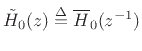 denotes the
paraconjugate of
(for real filters
denotes the
paraconjugate of
(for real filters  ). The
paraconjugate is the analytic continuation of
). The
paraconjugate is the analytic continuation of
 from
the unit circle to the
from
the unit circle to the  plane. Moreover, the analysis filters
are power symmetric, e.g.,
plane. Moreover, the analysis filters
are power symmetric, e.g.,
 |
(12.42) |
Let
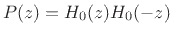 , such that
is a spectral factor of
the half-band filter
, such that
is a spectral factor of
the half-band filter  (i.e.,
  is a nonnegative power
response which is lowpass, cutting off near
is a nonnegative power
response which is lowpass, cutting off near
 ). Then,
(11.43) reduces to
). Then,
(11.43) reduces to
. It can be shown that any half-band
filter can be written in the form
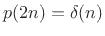 . That is, all
non-zero even-indexed values of
. That is, all
non-zero even-indexed values of  are set to zero.
A simple design of an FIR half-band filter would be to window a sinc function:
![$\displaystyle p(n) \eqsp \frac{\hbox{sin}[\pi n/2]}{\pi n/2}w(n)$](img2079.png) |
(12.45) |
 is any suitable window, such as the Kaiser window.
Note that as a result of (11.43), the CQF filters are power complementary. That is, they satisfy
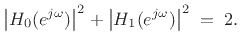 |
(12.46) |
and  are not linear phase. It
can be shown that there are no two-channel perfect reconstruction
filter banks that have all three of the following characteristics
(except for the Haar filters):
are not linear phase. It
can be shown that there are no two-channel perfect reconstruction
filter banks that have all three of the following characteristics
(except for the Haar filters):
By relaxing ``orthogonality'' to ``biorthogonality'', it becomes possible to obtain FIR linear phase filters in a critically sampled, perfect reconstruction filter bank. (See §11.9.)

![$\displaystyle \hat{X}(z) \eqsp \frac{1}{2}\left[H_0(z)H_0(z^{-1}) + H_0(-z)H_0(-z^{-1})\right]X(z) \protect$](img2071.png)
![$\displaystyle \hat{X}(z) \eqsp \frac{1}{2}\left[P(z) + P(-z)\right]X(z) \eqsp -z^{-(L-1)}X(z)$](img2076.png)