(defined in §B.10)
has a constant Fourier transform:
(defined in §B.10)
has a constant Fourier transform:
The impulse signal
(defined in §B.10)
has a constant Fourier transform:
 |
(B.43) |
 |
(B.44) |
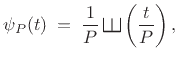
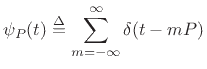
 is the period of the impulse train, in seconds--i.e.,
the spacing between successive impulses. The
-periodic
impulse train can also be defined as
is the period of the impulse train, in seconds--i.e.,
the spacing between successive impulses. The
-periodic
impulse train can also be defined as
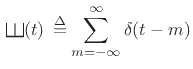
 is the so-called shah symbol [23]:
 |
(B.46) |
 in (B.46) is necessary to
maintain unit area under each impulse.
in (B.46) is necessary to
maintain unit area under each impulse.
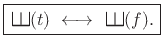
We will now show that
 |
(B.47) |
is exactly the same impulse train
 in the
frequency domain, where
in the
frequency domain, where  denotes time in seconds and
  denotes
frequency in Hz. By the scaling theorem (§B.4),
denotes
frequency in Hz. By the scaling theorem (§B.4),
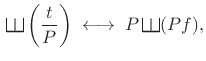 |
(B.48) |
-periodic impulse-train defined in (B.46)
transforms to
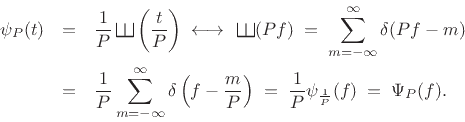
Thus, the
-periodic impulse train transforms to a  -periodic
impulse train, in which each impulse contains area
:
-periodic
impulse train, in which each impulse contains area
:
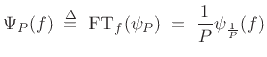 |
(B.49) |
Proof:
Let's set up a limiting construction by defining
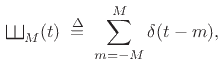 |
(B.50) |
 . We may interpret
 as a sampled rectangular pulse of width
  seconds (yielding
  samples).By linearity of the Fourier transform and the shift
theorem (§B.5), we readily obtain the transform of
to be
samples).By linearity of the Fourier transform and the shift
theorem (§B.5), we readily obtain the transform of
to be
![\begin{eqnarray*}
\hbox{\sc FT}_f(\,\raisebox{0.8em}{\rotatebox{-90}{\resizebox{1em}{1em}{\ensuremath{\exists}}}}_M) &\isdef & \hbox{\sc FT}_f\left[\sum_{m=-M}^M \hbox{\sc Shift}_{m}(\delta)\right]\\
&=& \sum_{m=-M}^M \hbox{\sc FT}_f[\hbox{\sc Shift}_{m}(\delta)] \eqsp \sum_{m=-M}^M e^{-j2\pi f m}.
\end{eqnarray*}](img2497.png)
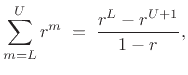
Using the closed form of a geometric series,
 |
(B.51) |
 , we can write this as
![\begin{eqnarray*}
\hbox{\sc FT}_f(\,\raisebox{0.8em}{\rotatebox{-90}{\resizebox{1em}{1em}{\ensuremath{\exists}}}}_M)
&=& \frac{e^{j2\pi f M } - e^{-j2\pi f M } e^{-j2\pi f }}{1-e^{-j2\pi f }}\\ [10pt]
&=& \frac{e^{-j\pi f}}{e^{-j\pi f}}
\cdot
\frac{e^{j\pi f (2M+1) } - e^{-j\pi f (2M+1) }}{e^{j\pi f}-e^{-j\pi f}}\\ [10pt]
&=& \frac{\sin[\pi f (2M+1) ]}{\sin(\pi f)}\\ [5pt]
&\isdef & (2M+1)\,\hbox{asinc}_{2M+1}(2\pi f )
\end{eqnarray*}](img2500.png)
where we have used the definition of
 given in
Eq.(3.5) of §3.1. As we would
expect from basic sampling theory, the Fourier transform of the
sampled rectangular pulse is an aliased sinc function.
Figure 3.2 illustrates one period
given in
Eq.(3.5) of §3.1. As we would
expect from basic sampling theory, the Fourier transform of the
sampled rectangular pulse is an aliased sinc function.
Figure 3.2 illustrates one period
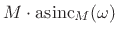 for
for
 .
.
The proof can be completed by expressing the aliased sinc function as
a sum of regular sinc functions, and using linearity of the Fourier
transform to distribute
 over the sum, converting each sinc
function into an impulse, in the limit, by §B.13:
over the sum, converting each sinc
function into an impulse, in the limit, by §B.13:
![\begin{eqnarray*}
(2M+1)\,\hbox{asinc}_{2M+1}(2\pi f) &\isdef &
\frac{\sin[\pi f (2M+1) ]}{\sin(\pi f)}\\ [5pt]
&=& \sum_{k=-\infty}^{\infty} \mbox{sinc}(2Mf-k)\\ [5pt]
&\to& \sum_{k=-\infty}^{\infty} \delta(f-k)
\end{eqnarray*}](img2503.png)
by §B.13.
Note that near
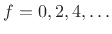 , we have
![\begin{eqnarray*}
\hbox{\sc FT}_f(\,\raisebox{0.8em}{\rotatebox{-90}{\resizebox{1em}{1em}{\ensuremath{\exists}}}}_M) &=& \frac{\sin[\pi f (2M+1) ]}{\sin(\pi f)}
\;\;\approx\;\; \frac{\sin[\pi f (2M+1) ]}{\pi f}\\ [5pt]
&=&(2M+1)\mbox{sinc}[(2M+1)f]
\;\;\to\;\;\delta(f)
\end{eqnarray*}](img2505.png)
as
 , as shown in §B.13. Similarly, near
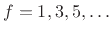 , we have
![$\displaystyle \hbox{\sc FT}_f(\,\raisebox{0.8em}{\rotatebox{-90}{\resizebox{1em}{1em}{\ensuremath{\exists}}}}_M) \;\;\approx\;\; \frac{\sin[\pi f (2M+1) ]}{-\pi f} \;\;\to\;\;\delta(f)$](img2508.png) |
(B.52) |
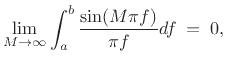
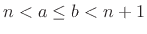
. Finally, we expect that the limit for non-integer
can be neglected since
 |
(B.53) |
 and
and  is some integer, as implied by
§B.13.
is some integer, as implied by
§B.13.
See, e.g., [23,79] for more about impulses and their application in Fourier analysis and linear systems theory.
Exercise: Using a similar limiting construction as before,
 |
(B.54) |
show that a direct inverse-Fourier transform calculation gives
![$\displaystyle \psi_{P,L}(t) = \frac{\sin\left[\pi(2L+1)\frac{t}{P}\right]}{\sin\left( \pi \frac{t}{P}\right)},$](img2512.png) |
(B.55) |
and verify that the peaks occur every. Also show that the peak widths, measured between zero crossings, are
, so that the area under each peak is of order 1 in the limit as
. [Hint: The shift theorem for inverse Fourier transforms is
, and
.]