Next |
Prev |
Up |
Top
|
Index |
JOS Index |
JOS Pubs |
JOS Home |
Search
The Continuous-Time Impulse
An impulse in continuous time must have ``zero width''
and unit area under it. One definition is
![$\displaystyle \delta(t) \isdef \lim_{\Delta \to 0} \left\{\begin{array}{ll} \frac{1}{\Delta}, & 0\leq t\leq \Delta \\ [5pt] 0, & \hbox{otherwise}. \\ \end{array} \right. \protect$](img2450.png) |
(B.26) |
An impulse can be similarly defined as the limit of any pulse
shape which maintains unit area and approaches zero width at time 0
[150]. As a result, the impulse under every definition has
the so-called
sifting property under integration,
 |
(B.27) |
provided  is continuous at
  . This is often taken as the
defining property of an impulse, allowing it to be defined in terms
of non-vanishing function limits such as
. This is often taken as the
defining property of an impulse, allowing it to be defined in terms
of non-vanishing function limits such as
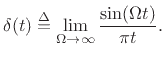 |
(B.28) |
(Note, incidentally, that
 is in
is in
 but not
 .)
.)
An impulse is not a function in the usual sense, so it is called
instead a distribution or generalized function
[36,150]. (It is still commonly called a ``delta function'',
however, despite the misnomer.)
Next |
Prev |
Up |
Top
|
Index |
JOS Index |
JOS Pubs |
JOS Home |
Search
[How to cite this work] [Order a printed hardcopy] [Comment on this page via email]