When a subset of the resonating modes is nearly harmonically tuned, it can be much more computationally efficient to use a filtered delay loop (see §2.6.5) to generate an entire quasi-harmonic series of modes rather than using a biquad for each modal peak [443]. In this case, the resonator model becomes
where
 is the length of the delay line in the
  th comb filter,
and
th comb filter,
and 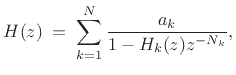 is a low-order filter which can be used to adjust finely
the amplitudes and frequencies of the resonances of the
th comb
filter [432]. Recall (Chapter 6) that a single
filtered delay loop efficiently models a distributed 1D
propagation medium such as a vibrating string or acoustic tube. More
abstractly, a superposition of such quasi-harmonic mode series can
provide a computationally efficient psychoacoustic equivalent
approximation to arbitrary collections of modes in the range of
human hearing.
is a low-order filter which can be used to adjust finely
the amplitudes and frequencies of the resonances of the
th comb
filter [432]. Recall (Chapter 6) that a single
filtered delay loop efficiently models a distributed 1D
propagation medium such as a vibrating string or acoustic tube. More
abstractly, a superposition of such quasi-harmonic mode series can
provide a computationally efficient psychoacoustic equivalent
approximation to arbitrary collections of modes in the range of
human hearing.
Note that when
is close to 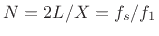 instead of
  , primarily
only odd harmonic resonances are produced, as has been used in
modeling the clarinet [435].
, primarily
only odd harmonic resonances are produced, as has been used in
modeling the clarinet [435].