Next |
Prev |
Up |
Top
|
Index |
JOS Index |
JOS Pubs |
JOS Home |
Search
Modal Expansion
A well known approach to transfer-function modeling is called
modal synthesis, introduced in §1.3.9
[5,301,6,146,384,30,,,].
Modal synthesis may be defined as constructing a source-filter
synthesis model in which the filter transfer function is implemented
as a sum of first- and/or second-order filter sections (i.e., as a
parallel filter bank in which each filter is at most
second-order--this was reviewed in §1.3.9). In other
words, the physical system is represented as a superposition of
individual modes driven by some external excitation (such as a pluck,
strike, or bow).
In acoustics, the term mode of vibration, or normal
mode, normally refers to a single-frequency spatial eigensolution
of the governing wave equation. For example, the modes of an ideal
vibrating string are the harmonically related sinusoidal string-shapes
having an integer number of uniformly spaced zero-crossings (or
nodes) along the string, including its endpoints. As first
noted by Daniel Bernoulli (§A.2), acoustic vibration
can be expressed as a superposition of component sinusoidal
vibrations, i.e., as a superposition of modes.9.6
When a single mode is excited by a sinusoidal driving force, all
points of the physical object vibrate at the same temporal frequency
(cycles per second), and the mode shape becomes proportional to the
spatial amplitude envelope of the vibration. The sound emitted from
the top plate of a guitar, for example, can be represented as a
weighted sum of the radiation patterns of the respective modes of the
top plate, where the weighting function is constructed according to
how much each mode is excited (typically by the guitar bridge)
[144,393,109,206,210].
Modal synthesis is concerned with modeling this entire transfer function,
from excitation point to listening point, as a sum of parallel
second-order mode transfer functions (``biquads''). It is rare
to see consideration of the spatial mode shape in modal synthesis.
The impulse-invariant method (§8.2), can be considered a
special case of modal synthesis in which a continuous-time  -plane
transfer function is given as a starting point. More typically, modal
synthesis starts with a measured frequency response, and a
second-order parallel filter bank is fit to that in some way. In
particular, any filter-design technique may be used (§8.6),
followed by a conversion to second-order parallel form.
-plane
transfer function is given as a starting point. More typically, modal
synthesis starts with a measured frequency response, and a
second-order parallel filter bank is fit to that in some way. In
particular, any filter-design technique may be used (§8.6),
followed by a conversion to second-order parallel form.
Modal expansions find extensive application in industry for
determining parametric frequency responses (superpositions of
second-order modes) from measured vibration data [301].
Each mode is typically parametrized in terms of its resonant
frequency, bandwidth (or damping), and gain (most generally complex
gain, to include phase).
Modal synthesis can also be seen as a special case of
source-filter synthesis, which may be defined as any signal
model based on factoring a sound-generating process into a filter
driven by some (usually relatively simple) excitation signal. An
early example of source-filter synthesis is the vocoder
(§A.6.1). Whenever the filter in a source-filter model is
implemented as a parallel second-order filter bank, we can call it
modal synthesis (although, strictly speaking, each filter section
should correspond to a resonant mode of the modeled resonant system).
Also related to modal synthesis is so-called formant synthesis,
used extensively in speech synthesis
[220,257,392,40,81,494,493,316,366,299].
A formant is simply a filter resonance having some
center-frequency, bandwidth, and (sometimes specified) gain. Thus, a
formant corresponds to a single mode of vibration in the vocal tract.
Many text-to-speech systems in use today are based on the Klatt
formant synthesizer for speech [257].
Since the importance of spectral formants in sound synthesis has more
to do with the way we hear than with the physical parameters of a
system, formant synthesis is probably best viewed as a spectral
modeling synthesis method [459], as opposed to a
physical modeling technique [439]. An exception to this
rule may occur when the system consists physically of a parallel bank
of second-order resonators, such as an array of tuning forks or
Helmholtz resonators. In such a case, the mode parameters correspond
to physically independent objects; this is of course rare in practice.
In the linear, time-invariant case, only modes in the range of human
hearing need to be retained in the model. Also, any ``uncontrollable''
or ``unobservable'' modes should obviously be left out as well. With
these simplificiations, the modal representation is generally more
efficient than an explicit mass-spring-dashpot digitization
(§7.3). On the other hand, since the modal representation
is usually not directly physical, nonlinear extensions may be
difficult and/or behave unnaturally.
As in the impulse-invariant method (§8.2), starting with an
order  transfer function
  describing the input-output
behavior of a physical system, a modal description can be obtained
immediately from the partial fraction expansion (PFE):
describing the input-output
behavior of a physical system, a modal description can be obtained
immediately from the partial fraction expansion (PFE):
 |
(9.9) |
where  denotes the
  th pole,
  is the
th zero, and
is the
th zero, and
 is the residue of the
th pole [452]. (For simplicity
of notation, Eq.(8.9) is written for the case
is the residue of the
th pole [452]. (For simplicity
of notation, Eq.(8.9) is written for the case  and
distinct. See [452] for the details when this is not the
case.) Since the system is real, complex poles will occur in complex
conjugate pairs. This means that for each complex term
and
distinct. See [452] for the details when this is not the
case.) Since the system is real, complex poles will occur in complex
conjugate pairs. This means that for each complex term
 ,
the PFE will also include the complex-conjugate term
,
the PFE will also include the complex-conjugate term
 . Such terms can be summed to create half
as many real second-order terms:
. Such terms can be summed to create half
as many real second-order terms:
 |
(9.10) |
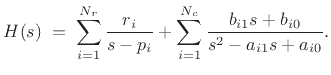
Let  denote the number of complex pole pairs, and
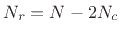 be the number of real poles. Then the modal expansion can be
written as
be the number of real poles. Then the modal expansion can be
written as
 |
(9.11) |
The real poles, if any, can be paired off into a sum of second-order
sections as well, with one first-order section left over when  is
odd. Note that each component second-order mode consists of one zero
and two poles. The zero is necessary to adjust the phase of the
resonant mode. The mode phase affects the frequency response at
frequencies between resonances (from smoothly varying to the
appearance of a deep notch somewhere between them).
is
odd. Note that each component second-order mode consists of one zero
and two poles. The zero is necessary to adjust the phase of the
resonant mode. The mode phase affects the frequency response at
frequencies between resonances (from smoothly varying to the
appearance of a deep notch somewhere between them).
A typical practical implementation of each mode in the sum is by means
of a second-order filter, or biquad section [452]. A
biquad section is easily converted from continuous- to discrete-time
form, such as by the impulse-invariant method of §8.2. The
final discrete-time model then consists of a parallel bank of
second-order digital filters
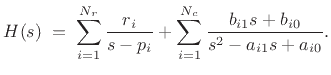 |
(9.12) |
where  when the number of real poles is even, or
 otherwise. The filter coefficients
  and
and  are now digital second-order section coefficients which can be
computed from the continuous-time filter coefficients, if they are
known, or they can be directly estimated from discrete-time data.
are now digital second-order section coefficients which can be
computed from the continuous-time filter coefficients, if they are
known, or they can be directly estimated from discrete-time data.
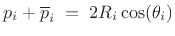
Expressing complex poles of  in polar form as
 , (where now we assume
denotes a pole in the
, (where now we assume
denotes a pole in the  plane), we obtain the classical relations [452]
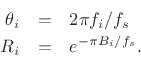
These parameters are in turn related to the modal parameters
resonance frequency  (Hz) and bandwidth
  (Hz) by
Often
and
are estimated from a measured log-magnitude
frequency-response (see §8.8 for a discussion of various methods).
It remains to determine the overall section gain  in
Eq.(8.12), and the coefficient
determining the zero location.
If
in
Eq.(8.12), and the coefficient
determining the zero location.
If  (as is common in practice, since the human ear is not very
sensitive to spectral nulls), then
can be chosen to match the
measured peak height. A particularly simple automatic method is to
use least-squares minimization to compute
using Eq.(8.12)
with
(as is common in practice, since the human ear is not very
sensitive to spectral nulls), then
can be chosen to match the
measured peak height. A particularly simple automatic method is to
use least-squares minimization to compute
using Eq.(8.12)
with  and
and  fixed (and
). Generally speaking,
least-squares minimization is always immediate when the error to be
minimized is linear in the unknown parameter (in this case
).
fixed (and
). Generally speaking,
least-squares minimization is always immediate when the error to be
minimized is linear in the unknown parameter (in this case
).
To estimate
in Eq.(8.12), an effective method is to work
initially with a complex, first-order partial fraction
expansion, and use least squares to determine complex gain
coefficients
for first-order (complex) terms of the form
as introduced in Eq.(8.9) above. The angle and radius of
can still be determined by measuring peaks in the log-magnitude
frequency response. When the first-order terms are paired and summed,
the
coefficients will ``fall out.''
Sections implementing two real poles are not conveniently specified in
terms of resonant frequency and bandwidth. In such cases, it is more
common to work with the filter coefficients
and  directly,
as they are often computed by system-identification software
[290,432] or general purpose filter design
utilities, such as in Matlab or Octave [446].
directly,
as they are often computed by system-identification software
[290,432] or general purpose filter design
utilities, such as in Matlab or Octave [446].
To summarize, numerous techniques exist for estimating modal
parameters from measured frequency-response data, and some of these
are discussed in §8.8 below. Specifically, resonant modes can be
estimated from the magnitude, phase, width, and location of peaks in
the Fourier transform of a recorded (or estimated) impulse response.
Another well known technique is Prony's method [452, p.
393], [299]. There is also a large literature on other
methods for estimating the parameters of exponentially decaying
sinusoids; examples include the matrix-pencil method
[276], and parametric spectrum analysis in general
[239].
Subsections
Next |
Prev |
Up |
Top
|
Index |
JOS Index |
JOS Pubs |
JOS Home |
Search
[How to cite this work] [Order a printed hardcopy] [Comment on this page via email]