 causes aliasing of any frequencies in the
original signal above
causes aliasing of any frequencies in the
original signal above
 , the input signal may need to
be first lowpass-filtered to prevent this aliasing, as shown in
Fig.11.5.
, the input signal may need to
be first lowpass-filtered to prevent this aliasing, as shown in
Fig.11.5.
Because downsampling by
causes aliasing of any frequencies in the
original signal above
, the input signal may need to
be first lowpass-filtered to prevent this aliasing, as shown in
Fig.11.5.
Suppose we implement such an anti-aliasing lowpass filter  as an
FIR filter of length
as an
FIR filter of length  with cut-off frequency
 .12.1 This is drawn in direct form in
Fig.11.6.
.12.1 This is drawn in direct form in
Fig.11.6.
![\includegraphics[width=0.6\twidth]{eps/down_FIR}](img1935.png) |
We do not need  out of every
filter output samples due to the
:
out of every
filter output samples due to the
: downsampler. To realize this savings, we can commute the
downsampler through the adders inside the FIR filter to obtain the
result shown in Fig.11.7. The multipliers are now running
at
downsampler. To realize this savings, we can commute the
downsampler through the adders inside the FIR filter to obtain the
result shown in Fig.11.7. The multipliers are now running
at  times the sampling frequency of the input signal
  .
This reduces the computation requirements by a factor of
. The
downsampler outputs in Fig.11.7 are called polyphase
signals. The overall system is a summed polyphase filter
bank in which each ``subphase filter'' is a constant scale factor
.
This reduces the computation requirements by a factor of
. The
downsampler outputs in Fig.11.7 are called polyphase
signals. The overall system is a summed polyphase filter
bank in which each ``subphase filter'' is a constant scale factor
 . As we will see, more general subphase filters can be used to
implement time-domain aliasing as needed for Portnoff windows
(§9.7).
. As we will see, more general subphase filters can be used to
implement time-domain aliasing as needed for Portnoff windows
(§9.7).
We may describe the polyphase processing in the anti-aliasing filter of Fig.11.7 as follows:
![$\displaystyle x(nN)\left\vert _{n=0}^{\infty}\right. \eqsp [x_0,x_N,x_{2N},\ldots]$](img1939.png) |
(12.3) |
 .
.
![$\displaystyle x(nN-1)\left\vert _{n=0}^{\infty}\right.\eqsp [x_{-1},x_{N-1},x_{2N-1},\ldots]$](img1940.png) |
(12.4) |
 ,
,


![$\displaystyle x(nN-m)\left\vert _{n=0}^{\infty}\right.\eqsp [x_{-m},x_{N-m},x_{2N-m},\ldots]
$](img1943.png)
is scaled by
 .
.
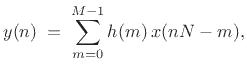 |
(12.5) |
 FIR filter
  , with its output downsampled by the factor
.
, with its output downsampled by the factor
.
The summed polyphase signals of Fig.11.7 can be interpreted
as ``serial to parallel conversion'' from an ``interleaved'' stream of
scalar samples
to a ``deinterleaved'' sequence of buffers (each
length
) every
samples, followed by an inner product of each
buffer with
![$ h = [h(0),\ldots,h(M-1)]$](img1946.png) . The same operation may be
visualized as a deinterleaving through variable gains into a running
sum, as shown in Fig.11.8.
. The same operation may be
visualized as a deinterleaving through variable gains into a running
sum, as shown in Fig.11.8.

![\includegraphics[width=2in]{eps/downsampledfilter}](img1932.png)
![\includegraphics[width=0.6\twidth]{eps/down_FIR_com}](img1936.png)
![\includegraphics[width=0.7\twidth]{eps/periodicGain}](img1947.png)