|
(6.1) |
A sinusoid is any signal of the form
|
(6.1) |
 is the amplitude (in arbitrary units),
 is the
phase in radians, and
is the
phase in radians, and  is the frequency in radians per
second. Time
is the frequency in radians per
second. Time  is a real number that varies
continuously from minus infinity to infinity in the ideal
sinusoid. All three parameters
is a real number that varies
continuously from minus infinity to infinity in the ideal
sinusoid. All three parameters
 are real numbers.
In addition to radian frequency
are real numbers.
In addition to radian frequency  , it is useful to define
 , where
  is the frequency in
Hertz (Hz).6.1
is the frequency in
Hertz (Hz).6.1
By Euler's identity,
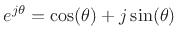 , we can write
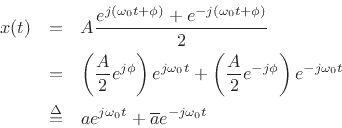
where
 denotes the complex conjugate of
  .
Thus, we can build a real sinusoid
.
Thus, we can build a real sinusoid  as a linear combination of
positive- and negative-frequency complex sinusoidal components:
as a linear combination of
positive- and negative-frequency complex sinusoidal components:
 |
(6.3) |
The spectrum of
is given by its
Fourier transform (see §2.2):
![\begin{eqnarray*}
X(\omega) &\isdef & \int_{-\infty}^{\infty} x(t) e^{-j\omega t} dt\nonumber \\ [5pt]
&=& \int_{-\infty}^{\infty} \left[a s_{\omega_0}(t) + \overline{a} s_{-\omega_0}(t)
\right] e^{-j\omega t} dt.
\end{eqnarray*}](img891.png)
In this case,
is given by (5.2) and we have
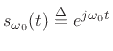 . For
. For
 ,
,
 may be called the
analytic signal corresponding to
.6.2
may be called the
analytic signal corresponding to
.6.2
It remains to find the Fourier transform of
 :
:
![\begin{eqnarray*}
S_{\omega_0}(\omega)
&=& \int_{-\infty}^{\infty} s_{\omega_0}(t) e^{-j\omega t} dt\\ [5pt]
&\isdef & \int_{-\infty}^{\infty} e^{j\omega_0 t} e^{-j\omega t} dt\\ [5pt]
&=& \int_{-\infty}^{\infty} e^{j(\omega_0-\omega) t} dt\\ [5pt]
&=& \left.\frac{1}{j(\omega_0-\omega)} e^{j(\omega_0-\omega) t}
\right\vert _{-\infty}^\infty\\ [5pt]
&=& \lim_{\Delta\to\infty} 2\frac{\sin[(\omega_0-\omega)\Delta]}{\omega_0-\omega}\\ [5pt]
&=& 2\pi\delta(\omega_0-\omega) = \delta(f_0-f),
\end{eqnarray*}](img897.png)
where
 is the delta function or impulse
at frequency
(see Fig.5.4 for a plot, and
§B.10 for a mathematical introduction).
Since the delta function is even (
is the delta function or impulse
at frequency
(see Fig.5.4 for a plot, and
§B.10 for a mathematical introduction).
Since the delta function is even (
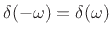 ),
we can also write
),
we can also write
 . It is shown in §B.13 that the
sinc
limit
above approaches a delta function
. It is shown in §B.13 that the
sinc
limit
above approaches a delta function
 .
However, we will only use the Discrete Fourier Transform (DFT)
in any practical applications, and in that case, the result is easy to
show [264].
.
However, we will only use the Discrete Fourier Transform (DFT)
in any practical applications, and in that case, the result is easy to
show [264].
The inverse Fourier transform is easy to evaluate by the sifting property6.3of delta functions:
 |
(6.6) |
Substituting into (5.4), the spectrum of our original sinusoid
is given by
![$\displaystyle X(\omega) = 2\pi\left[a \delta(\omega-\omega_0) + \overline{a}\delta(\omega+\omega_0)\right]$](img905.png) |
(6.7) |
 having
complex amplitude
having
complex amplitude
 , summed with another at
frequency
, summed with another at
frequency
 with complex amplitude
 .
.