denote a function differentiable for all
  such that
 and the Fourier transforms (FT) of both
and
and the Fourier transforms (FT) of both
and
 exist, where
denotes the time derivative
of
. Then we have
exist, where
denotes the time derivative
of
. Then we have
Let
denote a function differentiable for all
such that
and the Fourier transforms (FT) of both
and
exist, where
denotes the time derivative
of
. Then we have
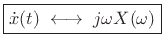 |
(B.4) |
 denotes the Fourier transform of
. In
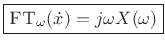
operator notation:
denotes the Fourier transform of
. In
operator notation:
 |
(B.5) |
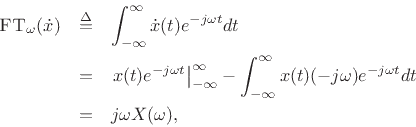
Proof:
This follows immediately from integration by parts:
since
.