Next  |  Prev  |  Up  |  Top  |  Index  |  JOS Index  |  JOS Pubs  |  JOS Home  |  Search


Cross-Correlation


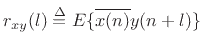
Definition: The cross-correlation of two signals $ x$ and $ y$ may be defined by

$\displaystyle r_{xy}(l) \isdef E\{\overline{x(n)}y(n+l)\}
$

I.e., it is the expected value of the lagged products in random signals $ x$ and $ y$ . In principle, the expected value must be computed by averaging $ x(n) y(n+l)$ over many realizations of the stochastic process $ x$ and $ y$ . That is, for each ``roll of the dice'' we obtain $ x(\cdot)$ and $ y(\cdot)$ for all time, and we can average $ x(n) y(n+l)$ across all realizations to estimate the expected value of $ x(n) y(n+l)$ . This is called an ``ensemble average'' across realizations of a stochastic process.

If the signals are stationary (which means their statistics are time-invariant), then we may replace ensemble averaging by averaging across time. In other words, for stationary stochastic processes, time averages equal ensemble averages.


Next  |  Prev  |  Up  |  Top  |  Index  |  JOS Index  |  JOS Pubs  |  JOS Home  |  Search

[How to cite this work] [Order a printed hardcopy]

``Spectral Audio Signal Processing'', by Julius O. Smith III, (August 2008 Draft).
Copyright © 2008-08-13 by Julius O. Smith III
Center for Computer Research in Music and Acoustics (CCRMA),   Stanford University
CCRMA  [Automatic-links disclaimer]