multiplies and
 additions, where
  is the number of
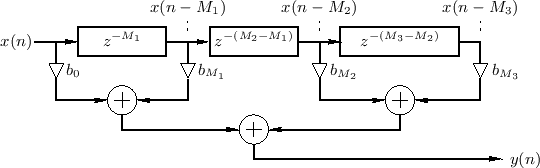
taps. This computational complexity is achieved by arranging the
additions into a binary tree, as shown in Fig.2.21 for the
case
is the number of
taps. This computational complexity is achieved by arranging the
additions into a binary tree, as shown in Fig.2.21 for the
case  .
.
When multiplies and additions can be performed in parallel, the
computational complexity of a tapped delay line is
multiplies and
additions, where
is the number of
taps. This computational complexity is achieved by arranging the
additions into a binary tree, as shown in Fig.2.21 for the
case
.
 |