
The definition of group delay,
does not give an immediately useful recipe for computing group delay numerically. In this section, we describe the theory of operation behind the matlab function for group-delay computation given in §J.8.
A more useful form of the group delay arises from the
logarithmic derivative of the frequency response. Expressing
the frequency response
 in polar form as
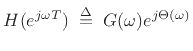
yields the following logarithmic decomposition of magnitude and phase:

Thus, the real part of the logarithm of the frequency response equals the log amplitude response, while the imaginary part equals the phase response.
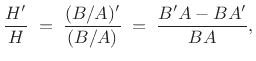
Since differentiation is linear, the logarithmic derivative becomes
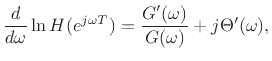
where
 and
and
 denote the
derivatives of
denote the
derivatives of  and
and
 , respectively, with
respect to
, respectively, with
respect to  . We may therefore express the group delay as
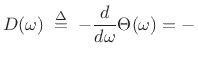 im
im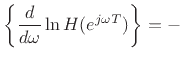 im
im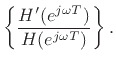
Consider first the FIR case in which
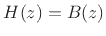 , with
![\begin{eqnarray*}
B^\prime(e^{j\omega T}) &\isdef & \frac{d}{d\omega}\left[b_0
+ b_1 e^{-j\omega T}
+ b_2 e^{-j2\omega T}
+ \cdots
+ b_M e^{-jM\omega T}\right]\\
&=& -jT\left[b_1 e^{-j\omega T}
+ 2\, b_2 e^{-j2\omega T}
+ \cdots
+ M\,b_M e^{-jM\omega T}\right]\\
&\isdef & -jT\,B_r(e^{j\omega T}),
\end{eqnarray*}](img946.png)
where  denotes ``
 ramped'', i.e., the
  th coefficient of
the polynomial
th coefficient of
the polynomial  is
is  , for
, for
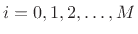 . In
matlab, we may compute Br from B via the
following statement:
. In
matlab, we may compute Br from B via the
following statement:
Br = B .* [0:M]; % Compute ramped B polynomialThe group delay of an FIR filter
 can now
be written as
can now
be written as
 im
im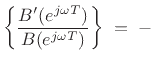 im
im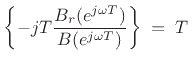 re
re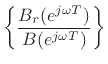
In matlab, the group delay, in samples, can be computed simply as
D = real(fft(Br) ./ fft(B))where the fft, of course, approximates the Discrete Time Fourier Transform (DTFT). Such sampling of the frequency axis by this approximation is information-preserving whenever the number of samples (FFT length) exceeds the polynomial order
 . The ratio of
sampled DTFTs, however, is undersampled, in general. In fact,
we may have
. The ratio of
sampled DTFTs, however, is undersampled, in general. In fact,
we may have
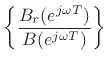 at some frequencies (``zeros on the unit
circle''). The grpdelay matlab utility in §J.8
watches out for division by zero, and simply sets the group delay to
zero at such frequencies. Note that the true group delay approaches
infinite magnitude as either a zero or pole approaches the unit circle.
at some frequencies (``zeros on the unit
circle''). The grpdelay matlab utility in §J.8
watches out for division by zero, and simply sets the group delay to
zero at such frequencies. Note that the true group delay approaches
infinite magnitude as either a zero or pole approaches the unit circle.
Finally, when there are both poles and zeros, we have
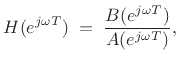
where
 is given in Eq.(7.9), and

may be called the ``flip-conjugate'' or ``Hermitian conjugate'' of the polynomial
 .8.4In matlab, the C polynomial is given by
C = conv(B,fliplr(conj(A)));It is straightforward to show (Problem 11) that

The phase of the IIR filter
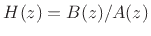 is therefore
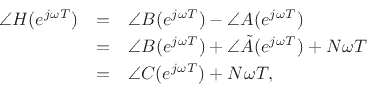
and the group delay computation thus reduces to the FIR case:
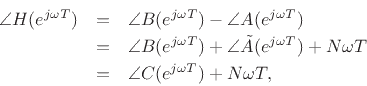 re
re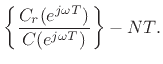
This method is implemented in §J.8.



![$\displaystyle C(z) \isdefs B(z)\left[ z^{-N}\overline{A}(1/z)\right] \isdefs B(z)\tilde{A}(z) \protect$](img960.png)