at each amplitude
  , where
  denotes the impulse
signal (
denotes the impulse
signal (
![$ [1,0,0,\ldots]$](img498.png) ).
).
There is no general theory of nonlinear systems. A nonlinear system with memory can be quite surprising. In particular, it can emit any output signal in response to any input signal. For example, it could replace all music by Beethoven with something by Mozart, etc. That said, many subclasses of nonlinear filters can be successfully analyzed:
at each amplitude
, where
denotes the impulse
signal (
).
One often-used tool for nonlinear systems analysis is Volterra series [4]. A Volterra series expansion represents a nonlinear system as a sum of iterated convolutions:

Here
 is the input signal,
  is the output signal, and the
impulse-response replacements
is the output signal, and the
impulse-response replacements  are called Volterra
kernels. The special notation
are called Volterra
kernels. The special notation
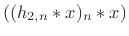 indicates that the second-order kernel
  is fundamentally
two-dimensional, meaning that the third term above (the first
nonlinear term) is written out explicitly as
is fundamentally
two-dimensional, meaning that the third term above (the first
nonlinear term) is written out explicitly as

Similarly, the third-order kernel
 is three-dimensional, in
general. In principle, every nonlinear system can be represented by
its (typically infinite) Volterra series expansion. The method is
most successful when the kernels rapidly approach zero as order
increases.
is three-dimensional, in
general. In principle, every nonlinear system can be represented by
its (typically infinite) Volterra series expansion. The method is
most successful when the kernels rapidly approach zero as order
increases.
In the special case for which the Volterra expansion reduces to

we have an immediate frequency-domain interpretation in which the output spectrum is expressed as a power series in the input spectrum: