Next |
Prev |
Top
|
JOS Index |
JOS Pubs |
JOS Home |
Search
All scattering matrices arising from the connection of  scalar
physical waveguides have the same basic structure which is an
efficient subset of the set of all lossless scattering matrices in
the sense of (26). To fix the setting, consider the parallel
junction of lossless acoustic tubes, each with real, positive,
scalar wave admittance
scalar
physical waveguides have the same basic structure which is an
efficient subset of the set of all lossless scattering matrices in
the sense of (26). To fix the setting, consider the parallel
junction of lossless acoustic tubes, each with real, positive,
scalar wave admittance  . The pressure at the junction is the
same for all waveguides at the junction point, and the
velocities from each branch sum to zero. These physical constraints
yield scattering matrices of the form
. The pressure at the junction is the
same for all waveguides at the junction point, and the
velocities from each branch sum to zero. These physical constraints
yield scattering matrices of the form
where  and
and
 are defined as follows:
 |
(39) |
![\begin{displaymath}{\mbox{\boldmath$\alpha$}}\stackrel{\triangle}{=}\frac{2}{\Gamma_J}[\Gamma_1,\dots,\Gamma_N]^T \end{displaymath}](img210.png) |
(40) |
It is easy to verify that the matrix
 satisfies the condition
of losslessness (26). In the particular case of
equal-impedance waveguides, we have
satisfies the condition
of losslessness (26). In the particular case of
equal-impedance waveguides, we have
We notice that the elements of each row of matrix
in (38) and (41) are allpass complementary,
i.e.,
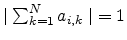 , for all
  . Since
the scattering matrix
. Since
the scattering matrix
 for equal-impedance waveguides is
symmetric, the elements of any row or column of matrix
for equal-impedance waveguides is
symmetric, the elements of any row or column of matrix
 are
allpass complementary. Since
remains unchanged in the
normalized case, the elements of each row and column are also power
complementary.
are
allpass complementary. Since
remains unchanged in the
normalized case, the elements of each row and column are also power
complementary.
The equal-impedance case is particularly important when is a power of
two. In this case, all the multiplications can be replaced by right-shifts
in fixed-point arithmetic, and considerable savings in circuit area
can be achieved in a VLSI implementation. This case has been explored in
the design of efficient digital waveguide meshes
[91,122,125].
The scattering matrix for a connection of normalized physical waveguides
is given by (32). It can be more explicitly written as
where
![\( {\mbox{\boldmath$\gamma$}}{\tiny\stackrel{\triangle}{=}}\frac{2}{\sqrt {\Gamma_J}}[{\sqrt
\Gamma_1},\dots,{\sqrt \Gamma_N}]^T \)](img220.png) , and the power-complementary
property (37) can be verified for both rows and columns.
, and the power-complementary
property (37) can be verified for both rows and columns.
In the expressions (38)-(42), the elements of the
matrices are real, since the one-variable waveguides intersecting at the
junction have real, positive impedances.
Normalized -way scattering junctions represented by real matrices can be
implemented by  CORDIC processors [38]. Since the scattering
matrix is orthogonal (real and unitary), it corresponds to a rotation in
dimensions. Any such rotation can be obtained by planar
rotations [34], with each planar rotation being realizable using a
CORDIC processor. This formulation can be useful for VLSI implementations.
CORDIC processors [38]. Since the scattering
matrix is orthogonal (real and unitary), it corresponds to a rotation in
dimensions. Any such rotation can be obtained by planar
rotations [34], with each planar rotation being realizable using a
CORDIC processor. This formulation can be useful for VLSI implementations.
The junction represented by the expressions (38)
to (42) is formally a parallel junction. The
corresponding series junction can be obtained by taking the dual of the parallel junction, i.e., by replacing admittance with
impedance and interchanging pressure and velocity. In the series
junction, the velocity is the same in all waveguides at the
junction, and the pressures (or forces) sum to zero.
Parallel junctions occur naturally in the case of intersecting
acoustic tubes, while series junctions arise at the intersection
of transversely vibrating strings,
where the transverse velocity must
be the same for all strings. For waves in strings, force waves
play the role of pressure waves in acoustic tubes.
Note that the wave equation
(1) for strings is usually written in terms of transverse
displacement. However, choosing velocity and force as Kirchhoff
variables unifies the treatment of vibrating strings with that of
acoustic tubes.
Subsections
Next |
Prev |
Top
|
JOS Index |
JOS Pubs |
JOS Home |
Search
Download wgj.pdf


![$\displaystyle \left[ \begin{array}{cccc}
\frac{2 \Gamma_{1}}{\Gamma_J} - 1 & \f...
...{2}}{\Gamma_J}
& \dots & \frac{2 \Gamma_{N}}{\Gamma_J} -1\\
\end{array}\right]$](img205.png)


![$\displaystyle \left[
\begin{array}{cccc}
\frac{2}{N} - 1 & \frac{2}{N} & \dots ...
...s \\
\frac{2}{N} & \frac{2}{N} & \dots & \frac{2}{N} -1\\
\end{array} \right]$](img212.png)


![$\displaystyle \left[
\begin{array}{llll}
\frac{2 \Gamma_{1}}{\Gamma_J} - 1
& \f...
..._{2}}}{\Gamma_J}
& \dots
& \frac{2 \Gamma_{N}}{\Gamma_J} -1
\end{array} \right]$](img218.png)