and
and  are said to be
independent if the probability of
and
occurring together equals the
product of the probabilities of
and
individually, i.e.,
are said to be
independent if the probability of
and
occurring together equals the
product of the probabilities of
and
individually, i.e.,
Two probabilistic events
and
are said to be
independent if the probability of
and
occurring together equals the
product of the probabilities of
and
individually, i.e.,
 |
(C.2) |
 denotes the probability of
and
occurring together.
denotes the probability of
and
occurring together.
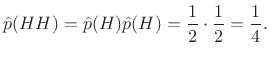
Example:
Successive coin tosses are normally independent.
Therefore, the probability of getting heads twice in a row is
given by
 |
(C.3) |