Next  |  Prev  |  Up  |  Top  |  Index  |  JOS Index  |  JOS Pubs  |  JOS Home  |  Search


Gaussian Window and Transform

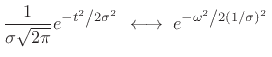
The Gaussian ``bell curve'' is the only smooth, nonzero function that transforms to itself:4.9

$\displaystyle \frac{1}{\sigma\sqrt{2\pi}}e^{-t^2 \left / 2\sigma^2\right.}
\leftrightarrow
e^{-\omega^2 \left/ 2\left(1/\sigma\right)^2\right.}
$

It also achieves the minimum time-bandwidth product
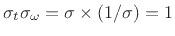
$\displaystyle \sigma_t\sigma_\omega = \sigma\times (1/\sigma) = 1
$

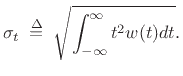
when ``width'' is defined as the square root of its second central moment. For even functions $ w(t)$ ,

$\displaystyle \sigma_t \isdef \sqrt{\int_{-\infty}^\infty t^2 w(t) dt}.
$

Since the true Gaussian function has infinite duration, in practice we must window it with some usual finite window, or truncate it.

Depalle [50] suggests using a triangular window raised to some power $ \alpha $ for this purpose, which preserves the absence of sidelobes for sufficiently large $ \alpha $ . It also preserves non-negativity of the transform.



Subsections
Next  |  Prev  |  Up  |  Top  |  Index  |  JOS Index  |  JOS Pubs  |  JOS Home  |  Search

[How to cite this work] [Order a printed hardcopy]

``Spectral Audio Signal Processing'', by Julius O. Smith III, (August 2008 Draft).
Copyright © 2008-08-13 by Julius O. Smith III
Center for Computer Research in Music and Acoustics (CCRMA),   Stanford University
CCRMA  [Automatic-links disclaimer]