Next  |  Prev  |  Up  |  Top  |  Index  |  JOS Index  |  JOS Pubs  |  JOS Home  |  Search


Generalized Scattering Coefficients

Figure G.36 depicts a section of a conical bore which widens to the right connected to a section which narrows to the right. In addition, the cross-sectional areas are not matched at the junction.

The horizontal $ x$ axis (taken along the boundary of the cone) is chosen so that $ x=0$ corresponds to the apex of the cone. Let $ A(x)=\alpha x^2$ denote the cross-sectional area of the bore.

Figure G.36: a) Physical picture. b) Waveguide implementation.
\includegraphics[width=\twidth]{eps/fconecone}

Since a piecewise-cylindrical approximation to a general acoustic tube can be regarded as a ``zeroth-order hold'' approximation. A piecewise conical approximation would then be a ``first-order hold'' approximation. However, this analogy with a Taylor series expansion is misleading. In zero-order sections (cylinders), plane waves propagate as traveling waves. In first-order sections (cones), spherical waves propagate as traveling waves. However, there are no traveling wave types for higher-order waveguide flare (e.g., quadratic or higher) [362].

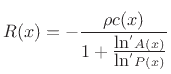
Since the digital waveguide model for a conic section is no more expensive to implement than that for a cylindrical section, (both are simply bidirectional delay lines), it would seem that modeling accuracy can be greatly improved for non-cylindrical bores (or parts of bores such as the bell) essentially for free. However, while the conic section itself costs nothing extra to implement, the scattering junctions between adjoining cone segments are more expensive computationally than those connecting cylindrical segments. However, the extra expense can be small. Instead of a single, real, reflection coefficient occurring at the interface between two cylinders of differing diameter, we obtain a first-order reflection filter at the interface between two cone sections of differing taper angle.

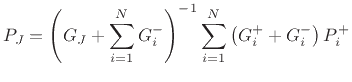
The generalization of scattering coefficients at a multi-tube intersection result in junction pressure being given by

$\displaystyle p_J = \left(G_J + \sum_{i=1}^N G_i^-\right)^{-1} \sum_{i=1}^N
\left(G_i^+ + G_i^- \right)p_i^+
$

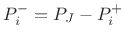
where $ G_i^+$ is the complex, frequency-dependent, incoming, acoustic admittance of the $ i$th branch at the junction, $ G_i^-$ is the corresponding outgoing acoustic admittance, $ p_i^+$ is the incoming traveling pressure wave phasor in branch $ i$, $ p_i^- = p_J - p_i^+$ is the outgoing wave, and $ G_J$ is the admittance of a load at the junction, such as a coupling to another simulation. For generality, the formula is given as it appears in the multivariable case.


Next  |  Prev  |  Up  |  Top  |  Index  |  JOS Index  |  JOS Pubs  |  JOS Home  |  Search

[How to cite this work]  [Order a printed hardcopy]

``Physical Audio Signal Processing'', by Julius O. Smith III, (August 2007 Edition).
Copyright © 2008-05-16 by Julius O. Smith III
Center for Computer Research in Music and Acoustics (CCRMA),   Stanford University
CCRMA  [About the Automatic Links]