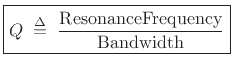
The quality factor (Q) of a resonator may be defined as the resonance frequency divided by the resonator bandwidth:
where the resonance frequency and bandwidth must be given in the same units (e.g., Hz). The resonance frequency is typically defined as the frequency at which the peak gain occurs. The bandwidth is typically defined as the 3dB-bandwidth, i.e., the bandwidth between the -3dB points (half-power-gain points) straddling the resonance frequency. A nearly equivalent definition of
 from mechanics is the amplitude
gain at resonance.
from mechanics is the amplitude
gain at resonance.
We define Q in the context of continuous-time resonators, so
that the transfer function  is the Laplace transform of
the continuous impulse-response
is the Laplace transform of
the continuous impulse-response  ,
,
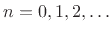
 (instead
of the z transform of the discrete-time impulse-response
(instead
of the z transform of the discrete-time impulse-response  ,
,
 ). An introduction to Laplace-transform analysis
appears in Appendix D.
). An introduction to Laplace-transform analysis
appears in Appendix D.
The concept of Q is routinely generalized to apply to any spectral magnitude peak for which the peak bandwidth can meaningfully be defined. For example, the fourth-order Moog VCF lowpass filter may have a ``corner resonance'' for which Q may be defined as the Q of the two-pole resonator causing the corner boost. More generally, there may be any number of physical resonators combining to create a single magnitude-peak in the frequency response, and the Q can still be defined clearly as peak-magnitude frequency divided by 3dB-bandwidth. At the other extreme, a spectral peak may involve no resonators at all when the impulse response is finite in duration. Thus, the most practical definition of Q for modern usage is peak frequency divided by peak bandwidth. However, because the term itself refers to the quality of a simple second-order resonator made using a capacitor and inductor, we will keep the historical definition and generalize as needed.