 radian, and the
side-lobe level is 13 dB down.
radian, and the
side-lobe level is 13 dB down.
From Fig.3.3 and Eq.(3.4), we see that the
main-lobe width is
radian, and the
side-lobe level is 13 dB down.
Since the DTFT of the rectangular window approximates the
sinc
function (see (3.4)), which has an amplitude envelope
proportional to  (see (3.7)), it should ``roll
off'' at approximately 6 dB per octave (since
(see (3.7)), it should ``roll
off'' at approximately 6 dB per octave (since
 ). This is verified in the log-log
plot of Fig.3.6.
). This is verified in the log-log
plot of Fig.3.6.
As the sampling rate approaches infinity, the rectangular window
transform (
 ) converges exactly to the
sinc
function.
Therefore, the departure of the roll-off from that of the
sinc
function can be ascribed to aliasing in the frequency domain,
due to sampling in the time domain (hence the name ``
'').
) converges exactly to the
sinc
function.
Therefore, the departure of the roll-off from that of the
sinc
function can be ascribed to aliasing in the frequency domain,
due to sampling in the time domain (hence the name ``
'').
Note that each side lobe has width
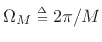 , as
measured between zero crossings.4.3 The main lobe, on the other hand, is
width
, as
measured between zero crossings.4.3 The main lobe, on the other hand, is
width  . Thus, in principle, we should never confuse
side-lobe peaks with main-lobe peaks, because a peak must be at least
wide in order to be considered ``real''. However, in
complicated real-world scenarios, side-lobes can still cause
estimation errors (``bias''). Furthermore, two sinusoids at closely
spaced frequencies and opposite phase can partially cancel each
other's main lobes, making them appear to be narrower than
.
. Thus, in principle, we should never confuse
side-lobe peaks with main-lobe peaks, because a peak must be at least
wide in order to be considered ``real''. However, in
complicated real-world scenarios, side-lobes can still cause
estimation errors (``bias''). Furthermore, two sinusoids at closely
spaced frequencies and opposite phase can partially cancel each
other's main lobes, making them appear to be narrower than
.
In summary, the DTFT of the  -sample rectangular window is
proportional to the `aliased sinc function':
-sample rectangular window is
proportional to the `aliased sinc function':
![\begin{eqnarray*}
\hbox{asinc}_M(\omega) &\isdef & \frac{\sin(\omega M / 2)}{M\cdot\sin(\omega/2)} \\ [0.2in]
&\approx& \frac{\sin(\pi fM)}{M\pi f} \isdefs \mbox{sinc}(fM)
\end{eqnarray*}](img344.png)
Thus, it has zero crossings at integer multiples of
 |
(4.11) |
and its first side-lobe is 13 dB
down from the main-lobe peak. As
gets bigger, the main-lobe
narrows, giving better frequency resolution (as discussed in the next
section). Note that the window-length
has no effect on
side-lobe level (ignoring aliasing). The side-lobe height is instead
a result of the abruptness of the window's transition from 1 to 0 in
the time domain. This is the same thing as the so-called
Gibbs phenomenon seen in truncated Fourier series expansions of
periodic waveforms. The abruptness of the window discontinuity in the
time domain is also what determines the side-lobe roll-off rate
(approximately 6 dB per octave). The relation of roll-off rate to the
smoothness of the window at its endpoints is discussed in
§B.18.

![\includegraphics[width=\textwidth ]{eps/rectWindowLLFT}](img338.png)