Next |
Prev |
Up |
Top
|
Index |
JOS Index |
JOS Pubs |
JOS Home |
Search
Rectangular Pulse
The rectangular pulse of width  centered on time 0 may be
defined by
centered on time 0 may be
defined by
![$\displaystyle p_\tau(t) \isdef \left\{\begin{array}{ll} 1, & \left\vert t\right\vert\leq\frac{\tau}{2} \\ [5pt] 0, & \left\vert t\right\vert>\frac{\tau}{2}. \\ \end{array} \right.$](img2456.png) |
(B.31) |
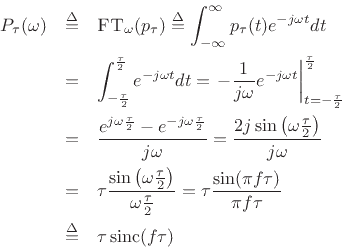
Its Fourier transform is easily evaluated:
Thus, we have derived the Fourier pair
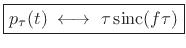 |
(B.32) |
Note that
sinc is the Fourier transform of the one-second
rectangular pulse:
is the Fourier transform of the one-second
rectangular pulse:
 sinc sinc |
(B.33) |
From this, the scaling theorem implies the more general case:
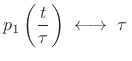 sinc sinc |
(B.34) |
Next |
Prev |
Up |
Top
|
Index |
JOS Index |
JOS Pubs |
JOS Home |
Search
[How to cite this work] [Order a printed hardcopy] [Comment on this page via email]