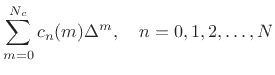
Von Neumann analysis is used to verify the stability of a finite-difference scheme. We will only consider one time dimension, but any number of spatial dimensions.
The procedure, in principle, is to perform a spatial Fourier transform along all spatial dimensions, thereby reducing the finite-difference scheme to a time recursion in terms of the spatial Fourier transform of the system. The system is then stable if this time recursion is at least marginally stable as a digital filter.
Let's apply von Neumann analysis to the finite-difference scheme for the ideal vibrating string Eq.(D.3):
There is only one spatial dimension, so we only need a single 1D Discrete Time Fourier Transform (DTFT) along
 [454].
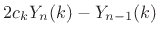
Using the shift theorem for the DTFT, we obtain
[454].
Using the shift theorem for the DTFT, we obtain
 denotes radian spatial frequency (wavenumber).
(On a more elementary level, the DTFT along
can be carried out by
substituting
denotes radian spatial frequency (wavenumber).
(On a more elementary level, the DTFT along
can be carried out by
substituting
 for
for  in the finite-difference scheme.)
This is now
a second-order difference equation (digital filter) that needs its
stability checked. This can be accomplished most easily using the
Durbin recursion [452], or we can check that the poles of the
recursion do not lie outside the unit circle in the
in the finite-difference scheme.)
This is now
a second-order difference equation (digital filter) that needs its
stability checked. This can be accomplished most easily using the
Durbin recursion [452], or we can check that the poles of the
recursion do not lie outside the unit circle in the  plane.
A method equivalent to checking the pole radii, and typically used
when the time recursion is first order, is to compute the
amplification factor as the complex gain  in
the relation
in
the relation
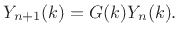
The finite-difference scheme is then declared stable if
 for all spatial frequencies
  .
.
Since the finite-difference scheme of the ideal vibrating string is so simple, let's find the two poles. Taking the z transform of Eq.(D.8) yields

yielding the following characteristic polynomial:
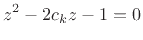
Applying the quadratic formula to find the roots yields
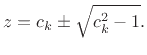
The squared pole moduli are then given by
![$\displaystyle \left\vert z\right\vert^2 = c_k^2 \pm (c_k^2 - 1) =
\left\{\begin{array}{ll}
[2c_k^2-1, 1], & \left\vert c_k\right\vert\geq 1 \\ [5pt]
[1,1], & \left\vert c_k\right\vert\leq 1 \\
\end{array} \right..
$](img4571.png)
Thus, for marginal stability, we require
 , and the
poles become
, and the
poles become

Since the range of spatial frequencies is
![$ k\in[-\pi/X,\pi/X]$](img4574.png) , we
spontaneously have
, we
spontaneously have
 for all
. Therefore, we have shown
by von Neumann analysis that the finite-difference scheme Eq.(D.3)
for the ideal vibrating string is stable.
for all
. Therefore, we have shown
by von Neumann analysis that the finite-difference scheme Eq.(D.3)
for the ideal vibrating string is stable.
In summary, von Neumann analysis verifies that no spatial Fourier components in the system are growing exponentially with respect to time.