Next |
Prev |
Up |
Top
|
Index |
JOS Index |
JOS Pubs |
JOS Home |
Search
Alternative Wave Variables
We have thus far considered discrete-time simulation of transverse
displacement  in the ideal string. It is equally valid to
choose velocity
in the ideal string. It is equally valid to
choose velocity
 , acceleration
 , slope
  , or perhaps some other derivative
or integral of displacement with respect to time or position.
Conversion between various time derivatives can be carried out by
means integrators and differentiators, as depicted in
Fig.C.10. Since integration and
differentiation are linear operators, and since the traveling
wave arguments are in units of time, the conversion formulas relating
,
, or perhaps some other derivative
or integral of displacement with respect to time or position.
Conversion between various time derivatives can be carried out by
means integrators and differentiators, as depicted in
Fig.C.10. Since integration and
differentiation are linear operators, and since the traveling
wave arguments are in units of time, the conversion formulas relating
,  , and
, and  hold also for the traveling wave components
 .
.
Figure C.10:
Conversions between various time
derivatives of displacement:  displacement,
 velocity,
 acceleration, where
  denotes
  and
and
 denotes
  .
.
![\includegraphics[scale=0.9]{eps/fwaveconversions}](img3447.png) |
Differentiation and integration have a simple form in the
frequency domain. Denoting the Laplace Transform of  by
by
 |
(C.36) |
where `` '' in the time argument means ``for all time,''
we have, according to the differentiation theorem for
Laplace transforms [286],
'' in the time argument means ``for all time,''
we have, according to the differentiation theorem for
Laplace transforms [286],
 |
(C.37) |
Similarly,
 , and so on. Thus, in
the frequency domain, the conversions between displacement, velocity,
and acceleration appear as shown in Fig.C.11.
, and so on. Thus, in
the frequency domain, the conversions between displacement, velocity,
and acceleration appear as shown in Fig.C.11.
Figure C.11:
Conversions between various time
derivatives of displacement in the frequency domain.
![\includegraphics[scale=0.9]{eps/ffdwaveconversions}](img3451.png) |
In discrete time, integration and differentiation can be accomplished
using digital filters [365]. Commonly used first-order
approximations are shown in Fig.C.12.
Figure C.12:
Simple approximate conversions between
time derivatives in the discrete-time case: a) The first-order
difference
 . b) The first-order
``leaky'' integrator
. b) The first-order
``leaky'' integrator
 with loss factor
  (slightly less than
  ) used to avoid
infinite dc build-up.
) used to avoid
infinite dc build-up.
![\includegraphics[width=\twidth]{eps/fdigitaldiffint}](img3452.png) |
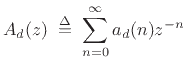
If discrete-time acceleration  is defined as the sampled version of
continuous-time acceleration, i.e.,
is defined as the sampled version of
continuous-time acceleration, i.e.,
 , (for some fixed continuous position
  which we
suppress for simplicity of notation), then the
frequency-domain form is given by the
which we
suppress for simplicity of notation), then the
frequency-domain form is given by the  transform
[488]:
transform
[488]:
 |
(C.38) |
In the frequency domain for discrete-time systems, the first-order
approximate conversions appear as shown in Fig.C.13.
Figure C.13:
Frequency-domain description of the
approximate conversions between time derivatives in the discrete-time
case. The subscript `` '' denotes the ``digital'' case. A ``hat''
over a variable indicates it is an approximation to the variable
without the hat.
'' denotes the ``digital'' case. A ``hat''
over a variable indicates it is an approximation to the variable
without the hat.
![\includegraphics[scale=0.6]{eps/ffddigitaldiffint}](img3456.png) |
The
transform plays the role of the Laplace transform for discrete-time
systems. Setting  , it can be seen as a sampled Laplace
transform (divided by
, it can be seen as a sampled Laplace
transform (divided by  ), where the sampling is carried out by halting
the limit of the rectangle width at
in the definition of a Reimann
integral for the Laplace transform. An important difference between the
two is that the frequency axis in the Laplace transform is the imaginary
axis (the ``
), where the sampling is carried out by halting
the limit of the rectangle width at
in the definition of a Reimann
integral for the Laplace transform. An important difference between the
two is that the frequency axis in the Laplace transform is the imaginary
axis (the `` axis''), while the frequency axis in the
plane is on
the unit circle
axis''), while the frequency axis in the
plane is on
the unit circle
 . As one would expect, the frequency axis for
discrete-time systems has unique information only between frequencies
. As one would expect, the frequency axis for
discrete-time systems has unique information only between frequencies
 and
and  while the continuous-time frequency axis extends to plus and
minus infinity.
while the continuous-time frequency axis extends to plus and
minus infinity.
These first-order approximations are accurate (though scaled by
)
at low frequencies relative to half the sampling rate, but they are
not ``best'' approximations in any sense other than being most like
the definitions of integration and differentiation in continuous time.
Much better approximations can be obtained by approaching the problem
from a digital filter design viewpoint, as discussed in §8.6.
Subsections
Next |
Prev |
Up |
Top
|
Index |
JOS Index |
JOS Pubs |
JOS Home |
Search
[How to cite this work] [Order a printed hardcopy] [Comment on this page via email]