Theorem: For any
 and any integer
  ,
,
Theorem: For any
and any integer
,
![$\displaystyle \zbox {\hbox{\sc DFT}_k[\hbox{\sc Shift}_\Delta(x)] = e^{-j\omega_k\Delta} X(k).}
$](img1355.png)
Proof:
![\begin{eqnarray*}
\hbox{\sc DFT}_k[\hbox{\sc Shift}_\Delta(x)] &\isdef & \sum_{n=0}^{N-1}x(n-\Delta) e^{-j 2\pi nk/N} \\
&=& \sum_{m=-\Delta}^{N-1-\Delta} x(m) e^{-j 2\pi (m+\Delta)k/N}
\qquad(m\isdef n-\Delta) \\
&=& \sum_{m=0}^{N-1}x(m) e^{-j 2\pi mk/N} e^{-j 2\pi k\Delta/N} \\
&=& e^{-j 2\pi \Delta k/N} \sum_{m=0}^{N-1}x(m) e^{-j 2\pi mk/N} \\
&\isdef & e^{-j \omega_k \Delta} X(k)
\end{eqnarray*}](img1356.png)
The shift theorem is often expressed in shorthand as
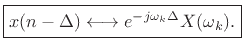
The shift theorem says that a delay in the time domain corresponds to a linear phase term in the frequency domain. More specifically, a delay of
samples in the time waveform corresponds to the linear
phase term
 multiplying the spectrum, where
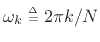 .7.14Note that spectral magnitude
is unaffected by a linear phase term. That is,
.7.14Note that spectral magnitude
is unaffected by a linear phase term. That is,
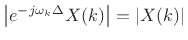 .
.