. The real impulse response
 of a zero-phase filter is even.11.1 That is, it satisfies
A zero-phase filter is a special case of a linear-phase filter
in which the phase slope is
. The real impulse response
of a zero-phase filter is even.11.1 That is, it satisfies

Note that every even signal is symmetric, but not every symmetric signal is even. To be even, it must be symmetric about time 0 .
A zero-phase filter cannot be causal (except in the trivial
case when the filter is a constant scale factor
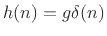 ).
However, in many ``off-line'' applications, such as when filtering a
sound file on a computer disk, causality is not a requirement, and
zero-phase filters are often preferred.
).
However, in many ``off-line'' applications, such as when filtering a
sound file on a computer disk, causality is not a requirement, and
zero-phase filters are often preferred.
It is a well known Fourier symmetry that real, even signals have real, even Fourier transforms [84]. Therefore,
This follows immediately from writing the DTFT of
 in terms of a cosine and sine transform:
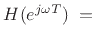 DTFT
DTFT
Since
is even, cosine is even, and sine is odd; and since even
times even is even, and even times odd is odd; and since the sum over
an odd function is zero, we have that
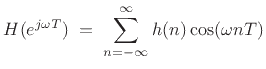
for any real, even impulse-response
. Thus, the frequency response
 is a real, even function of
  .
.
A real frequency response has phase zero when it is positive, and
phase  when it is negative. Therefore, we define
a zero-phase filter as follows:
when it is negative. Therefore, we define
a zero-phase filter as follows:
Recall from §7.5.2 that a passband is defined as a
frequency band that is ``passed'' by the filter, i.e., the filter is
not designed to minimize signal amplitude in the band. For example,
in a lowpass filter with cut-off frequency  rad/s, the
passband is
rad/s, the
passband is
![$ \omega\in[-\omega_c,\omega_c]$](img1183.png) .
.