is
is
A capacitor can be made physically using two parallel conducting plates which are held close together (but not touching). Electric charge can be stored in a capacitor by applying a voltage across the plates.
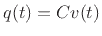
The defining equation of a capacitor
is
 denotes the capacitor's charge in Coulombs,
is the capacitance in Farads, and
denotes the capacitor's charge in Coulombs,
is the capacitance in Farads, and  is the
voltage drop across the capacitor in volts. Differentiating with
respect to time gives
is the
voltage drop across the capacitor in volts. Differentiating with
respect to time gives

where
 is now the current in
Amperes. Note that, by convention, the current is taken to be
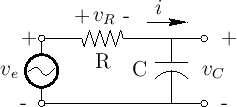
positive when flowing from plus to minus across the capacitor (see the
arrow in Fig.E.1 which indicates the direction of current
flow--there is only one current
is now the current in
Amperes. Note that, by convention, the current is taken to be
positive when flowing from plus to minus across the capacitor (see the
arrow in Fig.E.1 which indicates the direction of current
flow--there is only one current  flowing clockwise around the
loop formed by the voltage source, resistor, and capacitor when an
external voltage
flowing clockwise around the
loop formed by the voltage source, resistor, and capacitor when an
external voltage 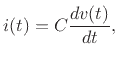 is applied).
Taking the Laplace transform of both sides gives

by the differentiation theorem for Laplace transforms (§D.4.2).
Assuming a zero initial voltage across the capacitor at time 0 , we have
We call this the driving-point impedance of the capacitor. The driving-point impedance facilitates steady state analysis (zero initial conditions) by allowing the capacitor to be analyzed like a simple resistor, with value
 Ohms.
Ohms.