Next |
Top
|
JOS Index |
JOS Pubs |
JOS Home |
Search
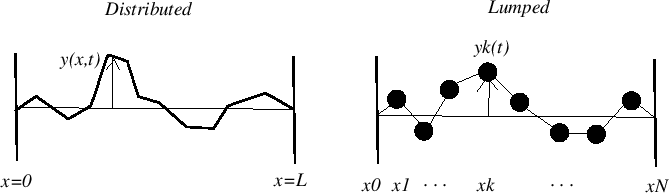
For example, consider the following two systems:
- The first system is a distributed system, consisting of
an infinitely thin string, supported at both ends; the dependent
variable, the vertical position of the string
 is indexed
continuously in both space and time.
is indexed
continuously in both space and time.
- The second system, a series of ``beads'' connected by massless
string segments, constrained to move vertically, can be thought of as
a lumped system, perhaps an approximation to the continuous
string.
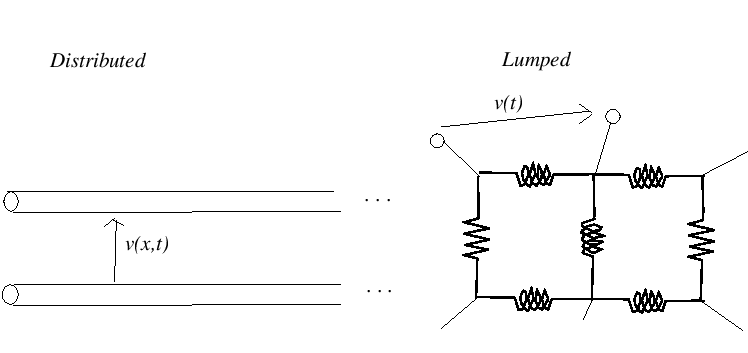
- For electrical systems, consider the difference between a lumped RLC network and a transmission line
- The importance of lumped approximations to distributed
systems will become obvious later, especially for waveguide-based
physical modeling, because it enables one to cut computational costs
by solving ODEs at a few points, rather than a full PDE (generally
much more costly)
Next |
Top
|
JOS Index |
JOS Pubs |
JOS Home |
Search
Download NumericalInt.pdf
Download NumericalInt_2up.pdf
Download NumericalInt_4up.pdf
 [Automatic-links disclaimer]