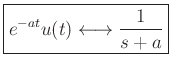
We can quickly verify that
where
 is the Heaviside unit step function which steps from
0 to 1 at time 0
.
is the Heaviside unit step function which steps from
0 to 1 at time 0
.
By linearity, the solution for the motion of the mass is
![\begin{eqnarray*}
x(t) &=& re^{-j{\omega_0}t} + \overline{r}e^{j{\omega_0}t}
= 2\mbox{re}\left\{re^{-j{\omega_0}t}\right\}
= 2R_r\cos({\omega_0}t - \theta_r)\\
&=& \frac{\sqrt{v^2_0 + {\omega_0}^2 x^2_0}}{{\omega_0}}
\cos\left[{\omega_0}t - \tan^{-1}\left(\frac{v_0}{{\omega_0}x_0}\right)\right]
\end{eqnarray*}](img71.png)
If the initial velocity is zero ( ), the above formula
reduces to
), the above formula
reduces to
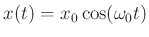 and the mass simply oscillates sinusoidally at frequency
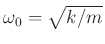 , starting from its initial position
  .
If instead the initial position is
.
If instead the initial position is  , we obtain
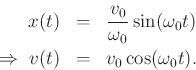
 [Automatic-links disclaimer]