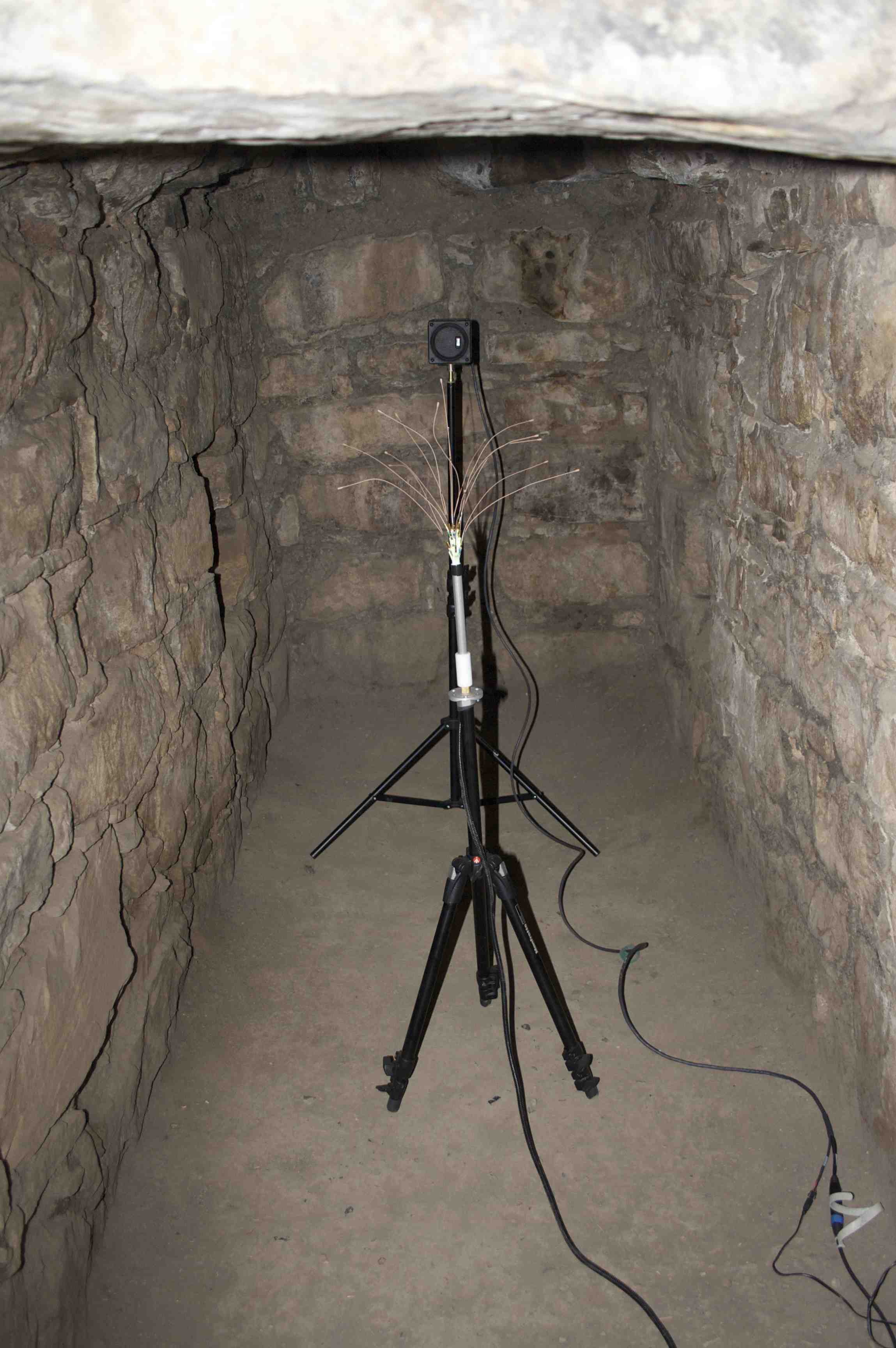

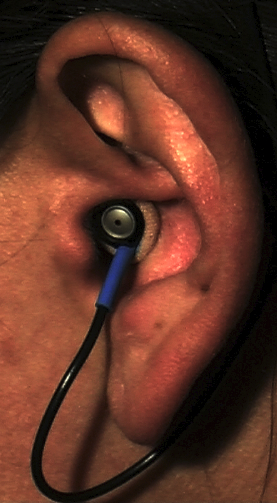
Above, left: Acoustic measurement setup in Chavín gallery; center: Tito La Rosa performing Chavín pututu; right: in-ear microphone used in binaural measurements.
Photos: José Luis Cruzado Coronel
Above, left: Acoustic measurement setup in Chavín gallery; center: Tito La Rosa performing Chavín pututu; right: in-ear microphone used in binaural measurements.
Photos: José Luis Cruzado Coronel
Archaeology seeks contextualized material evidence from the human past, in order to understand ancient life; archaeoacoustics additionally incorporates the tools and methods of acoustics, audio digital signal processing, psychoacoustics, musicology, ethnography, sound art, and other fields to study how sound could have been important to ancient peoples and places, in all the ways we understand now.
Sound is ephemeral, but in the modern world we are accustomed to its preservation and reproduction through audio recordings, musical scores, and other forms of historical data. In archaeoacoustics, we look to sound-producing instruments, architectural remains, and landform settings to provide clues for re-constructing and exploring ancient sounds and sound environments.
The well-preserved enclosed architecture of Chavín's buildings allows us to make acoustic measurements that show how these spaces transmit and filter sound, which provides information about how site architecture can create perceptible sonic effects.
Because intact sound-producing instruments -- the conch-shell "trumpets" or musical horns known today in the Andes as "pututus" -- have been excavated at Chavín, we can study and record how these artifact instruments sound, and measure their acoustics.
A comparison between the sounding characteristics of the pututus and the site's spatial acoustic features provides clues about how these instruments may have contributed to the ancient sound environment at the complex.
Acoustic dynamics of instruments and architecture create perceptual effects for human listeners. Contextualized psychoacoustic experiments with human participants, conducted on site in these extant architectural settings, allow us to test how site acoustics and artifact instrument sounds interact to produce sensory effects. Systematic experiments provide a way of assessing the potential variety of sound environment perceptions as well as the strong perceptual trends that particular acoustics commonly create for listeners.
Our newest research is to create auralizations that demonstrate aspects of the ancient sound environment at Chavín.